You Won’t Believe What I Found Exploring Killarney Alone
Nestled in the heart of County Kerry, Killarney isn’t just a pretty face—its wild lakes, ancient woodlands, and vibrant streets offer experiences that stay with you long after you leave. I went seeking quiet adventure and found something deeper: a place where nature, history, and local charm collide in the most unexpected ways. If you're craving authenticity over crowds, let me show you the real pulse of Ireland. This is not about ticking off landmarks or snapping photos for social media. It’s about stepping into a rhythm older than tourism, where mist rolls across lakes at dawn, stone ruins whisper stories, and a fiddle tune in a backstreet pub can feel like a welcome home. Killarney, when explored with intention, becomes more than a destination—it becomes a quiet revelation.
Why Killarney? The Allure of a Private Escape
Killarney stands apart not because it’s untouched by tourism, but because it resists being reduced to it. While other Irish towns have leaned heavily into souvenir shops and staged performances, Killarney maintains a quiet authenticity beneath its visitor-friendly surface. Its location within County Kerry, a region long celebrated for unspoiled landscapes and enduring traditions, gives it a rootedness that feels genuine. The town sits at the gateway to Killarney National Park, a 26,000-acre sanctuary of lakes, woodlands, and mountains, offering immediate access to solitude even when the streets are lively. For travelers—especially women between 30 and 55 seeking meaningful, reflective journeys—this balance is invaluable.
What makes Killarney ideal for a personal retreat is its ability to cater to both comfort and adventure. You can stay in a well-appointed guesthouse with tea and scones served each morning, then disappear into the wilderness by midday. The town’s walkable center, lined with family-run cafes and independent bookshops, invites slow exploration. Unlike destinations that demand constant movement or high energy, Killarney allows space to breathe. You can sit on a bench by the lake with a journal, listen to the chime of church bells, and feel not like an outsider, but like someone who has been gently let in on a long-held secret.
Choosing Killarney for a solo journey is not about escaping life, but about re-engaging with it on quieter terms. The pace here supports introspection. There’s no pressure to perform or impress. A woman traveling alone might draw curious glances in other places, but in Killarney, she’s simply another visitor enjoying the morning light on the water. Locals are polite without intrusion, offering a nod or a quiet “mornin’” as you pass. This subtle respect for personal space, combined with underlying warmth, creates an environment where solitude feels safe, even nurturing. It’s a rare balance—being seen without being scrutinized, welcomed without being overwhelmed.
Moreover, Killarney’s infrastructure supports independent travel without sacrificing authenticity. Public transport connects key sites, but the real magic unfolds when you step off the bus and onto a footpath only locals seem to know. The town is compact enough to navigate without a car, yet it opens directly into vast natural expanses where you can walk for hours without seeing another soul. This accessibility, paired with genuine remoteness just beyond the edges, makes Killarney a standout choice for those who want both connection and quiet. It’s not about avoiding people, but about choosing when and how to engage—on your own terms.
Sunrise at Muckross Lake: A Moment of Stillness
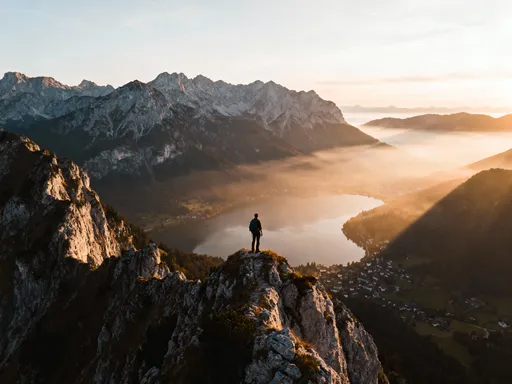
There is a particular kind of peace that only comes at dawn by the water. I arrived at Muckross Lake just as the sky began to lighten, the world still wrapped in a hush so deep it felt almost sacred. The surface of the lake was smooth as glass, holding the reflection of the surrounding hills like a mirror. Mist curled upward in slow spirals, dissolving as the first gold of sunlight touched the peaks of Mangerton Mountain. There were no crowds, no tour groups, not even a jogger on the path. Just the occasional dip of an oar from a distant swan and the soft cry of a curlew from the reeds.
Standing there, wrapped in a woolen scarf with the cool air brushing my face, I felt a rare clarity. This was not the forced tranquility of a spa or a meditation app, but something earned—something that came from showing up early, from choosing stillness over convenience. The scent of damp earth and pine needles rose from the shoreline. A red squirrel darted across the path ahead, pausing just long enough to glance my way before vanishing into the undergrowth. These small, unscripted moments accumulated into a sense of presence I hadn’t felt in years.
What made the experience so powerful was the absence of distraction. No phone signal, no need to document, no one expecting anything from me. Just the slow unfolding of light and the steady rhythm of my own breath. In that silence, the landscape didn’t feel passive—it felt alive, watchful, generous. The lake wasn’t just a scenic backdrop; it was a participant in the morning, changing with each passing minute as shadows retreated and colors deepened. The water shifted from silver to blue to a warm amber as the sun climbed higher.
For women who spend their days managing households, careers, or extended families, this kind of solitude can feel revolutionary. It’s not selfish—it’s restorative. And Killarney offers it freely, without drama or difficulty. You don’t need special gear or a guide. You just need the courage to wake up early and show up alone. The reward isn’t a photo or a souvenir, but a memory etched in feeling: the chill of the morning air, the soft lap of water against stone, the quiet certainty that you are exactly where you need to be.
Hiking the Old Kenmare Road: Walking Through Time
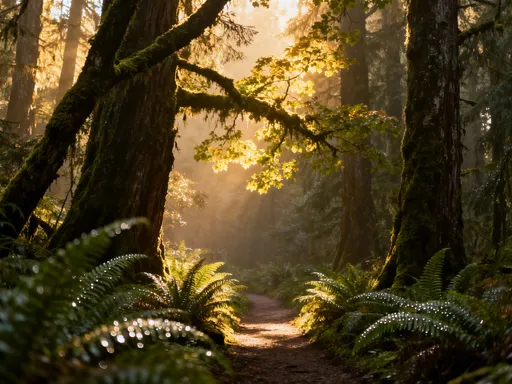
One of the most profound ways to experience Killarney’s depth is to walk the Old Kenmare Road, a 10-kilometer trail that cuts through the heart of Killarney National Park. Built in the 1820s as a military road, it connected Killarney to the remote village of Kenmare, serving as a vital link in a time before modern transport. Today, it’s a ribbon of history winding through oak woodlands, past rushing streams, and beneath the watchful presence of Purple Mountain. The stones underfoot are worn smooth by centuries of use, and as you walk, it’s easy to imagine horse-drawn carriages, mail carriers, and travelers seeking shelter from the Irish rain.
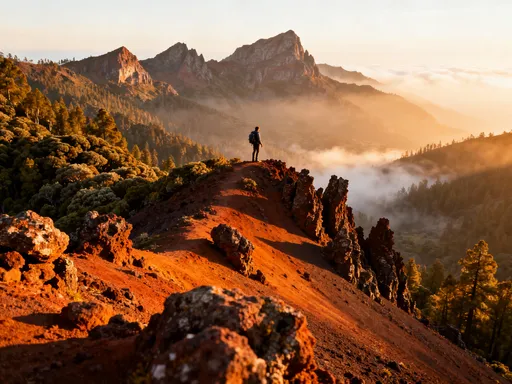
The trail begins near the Muckross Estate and climbs gently into the hills, offering panoramic views that unfold with each turn. In spring, the path is lined with wood anemones and bluebells; in autumn, the oak trees blaze with color. The air carries the crisp scent of moss and wet stone, and the only sounds are the wind in the treetops and the occasional call of a raven. This is not a hike for adrenaline seekers—it’s a pilgrimage for those who value reflection. There are no dramatic drops or technical climbs, just a steady, meditative pace that matches the rhythm of thoughtful walking.
One of the most moving aspects of this trail is the chance to see native red deer in their natural habitat. These animals, descendants of Ireland’s original wild deer population, roam freely through the park. I paused once as a small herd emerged from the mist, their antlers catching the morning light. They moved with quiet dignity, pausing to graze before disappearing into the trees. No fences, no signs, no crowds—just a moment of pure wildness shared between strangers of different species.
For the best experience, enter the trail early in the morning or late in the afternoon, when most tour groups have moved on. Wear sturdy walking shoes with good grip, as the path can be uneven and slippery after rain. Bring a light rain jacket—Irish weather changes quickly—and a small backpack with water and a snack. But leave the headphones behind. The silence here is part of the journey. Let the crunch of gravel underfoot, the distant murmur of a stream, and the rustle of leaves be your soundtrack. This trail isn’t about conquering nature; it’s about walking with it, listening to its quiet wisdom.
The Hidden Pub That Feels Like Home
Not every meaningful moment in Killarney happens in the wilderness. Some of the most lasting impressions come from unexpected human connections—in this case, a small, unmarked pub tucked down a side street near the cathedral. There’s no sign that says “tourists welcome,” no neon Guinness logo, no menu written in five languages. Just a heavy wooden door, a flickering oil lamp, and the sound of a fiddle tuning up inside.
I stepped in out of the rain one afternoon and was met with warmth—both from the crackling peat fire in the hearth and from the nod of recognition from the bartender, who didn’t ask what I wanted but simply poured a hot whiskey and set it down with a quiet “There you go.” The room was small, with mismatched chairs, a well-worn rug, and a corner where three older men were tuning instruments. Within minutes, the first notes of a reel filled the air, soft at first, then building in energy. A woman in a wool sweater began to hum along. No one was performing for an audience; they were playing because it felt right.
What struck me was the absence of performance. This wasn’t a show for visitors—it was a ritual, a way of holding community together. And yet, there was no exclusion. When I smiled at the man beside me during a particularly lively tune, he leaned over and said, “That one’s been in the family for three generations.” No grand explanation, just a quiet offering of belonging. I didn’t need to speak much. I didn’t need to prove I belonged. I just needed to be present, to listen, to let the music wash over me.
Respecting the space matters. That means not taking photos, not interrupting conversations, not treating the moment as content. It means tipping generously, saying thank you, and leaving quietly when the last note fades. These small gestures are how travelers honor places like this. They’re not hidden because they want to stay secret—they’re hidden because they refuse to be commodified. To find them is a gift, and the proper response is gratitude, not exploitation. For a woman traveling alone, such moments can be deeply affirming—a reminder that connection doesn’t require grand gestures, just openness and respect.
Rowing Across Lough Leane: A Personal Pilgrimage
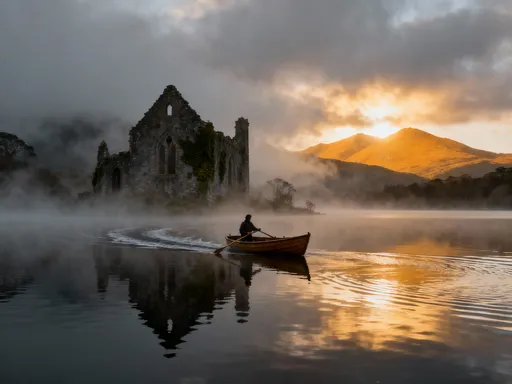
One of the most intimate ways to experience Killarney’s landscape is to row yourself across Lough Leane toward Innisfallen Abbey. The rental dock is unassuming—a small wooden platform near the southern edge of the lake, run by a quiet man who checks your life jacket and says, “Take your time.” The boat is a simple rowing skiff, weathered but sturdy, with oars that slide smoothly into the locks. As you push off, the world shrinks to the sound of water dripping from the blades and the rhythmic pull of your arms.
The journey takes about twenty minutes, depending on your pace. At first, the shoreline recedes slowly, then the open water widens around you. You’re no longer a spectator—you’re part of the scene. Birds rise from the reeds as you pass. A heron stands statue-still on a half-submerged log. The wind carries the scent of waterweed and distant rain. And then, as you round a small headland, the abbey appears—a cluster of ancient stone walls rising from the green island, cloaked in ivy and silence.
Innisfallen Abbey dates back to the 7th century, founded by St. Finian the Leper. For centuries, it served as a center of learning and spirituality, its monks recording Irish history in what became known as the Annals of Innisfallen. To step onto the island is to step into layers of time. The stones are cool to the touch, worn smooth by weather and centuries of hands. Moss grows in the cracks. A single wooden bench faces the water, as if waiting for a visitor who never left.
What made this experience transformative was the effort it took to reach it. Unlike a boat tour, where you arrive passively, rowing demands presence. Your body becomes part of the journey. Each stroke is a choice. The ache in your shoulders, the steadiness of your breathing, the focus required to stay on course—these physical sensations anchor you in the moment. There’s no distraction, no commentary from a guide. Just you, the water, and the slow emergence of history from the mist. It’s a rare kind of pilgrimage—one that doesn’t require faith in doctrine, but in the value of showing up, of moving forward with your own strength.
Cycling the Gap of Dunloe: Thrill with a View
For those seeking a more active adventure, cycling the Gap of Dunloe offers a perfect blend of challenge and beauty. This narrow mountain pass, carved by glaciers thousands of years ago, cuts through the MacGillycuddy’s Reeks, Ireland’s highest mountain range. The route stretches about 11 kilometers from Kate’s Cottage to Lord Brandon’s Cottage, winding through dramatic cliffs, sparkling lakes, and sweeping valleys. It’s not a ride for beginners—the road is steep in parts, often narrow, and can be slick after rain—but the views are worth every pedal stroke.
I rented a hybrid bike from a shop in town, choosing one with wide tires and reliable brakes. The owner advised starting early to avoid both traffic and afternoon showers. As I began the ascent, the town faded behind me, replaced by towering rock faces and the sound of a mountain stream rushing beside the road. The air was crisp, carrying the scent of heather and wet stone. Every few minutes, a new vista opened—a lake reflecting the sky like polished steel, a waterfall tumbling down a distant slope, a pair of peregrine falcons circling above.
One of the joys of cycling this route is the ability to move at your own pace. You can stop whenever you like—to catch your breath, to take in a view, to watch a family of mountain goats on a ledge above. There are no strict schedules, no packed tour buses rushing you along. It’s just you, the road, and the rhythm of your own effort. I paused at the highest point, where the wind was strong and the views stretched for miles. Below, the five lakes of the Gap shimmered in sequence, connected like beads on a string. It felt like standing at the roof of Kerry, looking out over a world shaped by ice and time.
Safety is important. Wear a helmet, bring water and a light snack, and check the weather before you go. The road is shared with tour cars and pony traps, so stay alert, especially on blind curves. But don’t let caution keep you from trying it. This ride isn’t about speed or endurance—it’s about immersion. It’s about feeling the burn in your legs as you climb, the rush of cool air as you descend, and the deep satisfaction of having seen something few visitors experience on their own power. For women who may have spent years putting others first, this kind of self-reliant adventure can be quietly empowering.
How to Travel Killarney Your Way—Without Losing the Magic
Killarney’s true magic lies not in any single attraction, but in the space between them—the quiet moments, the unplanned detours, the decisions to linger a little longer. To experience it fully, it helps to travel with intention. That means planning enough to feel secure, but leaving room for spontaneity. Visit in the shoulder seasons—April to May or September to October—for milder weather and fewer crowds. Book accommodations in advance, but don’t over-schedule your days. Let the town and the landscape guide you.
Balance is key. Spend a morning at Muckross House and Gardens if you like, but follow it with an hour on a quiet lakeside bench. Take a guided tour if it helps you understand the history, but also set aside time to explore on your own. The most meaningful experiences often come from small choices: turning down an unfamiliar lane, accepting an invitation to sit by the fire, saying yes to a boat ride you hadn’t planned.
And above all, practice mindfulness. Put your phone away. Listen more than you speak. Notice the way light falls on a stone wall, the pattern of rain on a window, the sound of Irish spoken softly in a shop. These details are the fabric of place. They don’t make for flashy photos, but they stay with you—long after the trip ends.
Killarney is not just a destination. It’s a reminder that travel can be gentle, reflective, and deeply personal. It’s proof that you don’t need to chase extremes to feel alive. Sometimes, all it takes is a morning by the lake, a walk through ancient woods, or a fiddle tune in a quiet pub to remember who you are. So go. Not to escape, but to return—to yourself, to stillness, to the quiet pulse of a place that welcomes you just as you are.