Hiking Through Hanok Hills: Where Busan’s Architecture Meets the Trail
You know that feeling when you're hiking and suddenly stumble upon something completely unexpected? That’s exactly what happened when I hit the trails around Busan. It’s not just about ocean views or mountain peaks—this city blends traditional Korean architecture into the natural landscape in ways I never imagined. Wooden hanok rooftops peek through pine forests, modern designs cling to cliffs, and every turn offers a new fusion of culture and nature. If you think hiking is just about the climb, wait until you see how Busan builds beauty into the hills. This is not a city that conquers its terrain; it listens to it, learns from it, and responds with structures that feel like they’ve always belonged. Here, every path tells a story—not only of elevation and endurance but of design, heritage, and harmony.
Why Hiking in Busan Feels Different
Most cities offer hiking as an escape from urban life—a way to leave behind concrete and noise for solitude among trees and sky. But in Busan, the trail doesn’t mark a boundary between city and wilderness. Instead, it weaves them together. The topography of this southeastern port city is defined by steep coastal hills that rise abruptly from residential neighborhoods, creating a unique interplay between built environments and natural slopes. These aren’t just mountains near a city; they are mountains within it, threaded through with paths that pass temples, pavilions, old village homes, and even contemporary architectural installations.
What sets Busan apart is how seamlessly architecture becomes part of the hiking experience. Elsewhere, hikers might expect rustic shelters or simple signage at best. In Busan, you encounter carefully restored stone walls, centuries-old gateways, and wooden walkways that follow the contours of the land with precision. Even modern additions—like viewing platforms or trailside rest areas—are designed to complement rather than dominate the surroundings. This integration reflects a deep cultural respect for landscape, one rooted in Korea’s long-standing tradition of aligning human construction with natural flow.
The result is a kind of hiking that engages more than just the body. While your legs work up inclines and your lungs adjust to altitude, your eyes are drawn to subtle architectural details: the curve of a tiled roof echoing the shape of a ridge, the way a wooden bridge frames a valley below, or how a stone staircase seems to grow naturally from the hillside. It’s an experience that rewards slow movement and attentive observation. Whether you're drawn to history, design, or simply the peace of being outdoors, Busan’s trails invite you to see architecture not as something separate from nature, but as its thoughtful companion.
Geumjeongsan: Fortress Walls and Forest Paths
Rising over 800 meters above sea level, Geumjeongsan is one of Busan’s most prominent peaks and a favorite among local hikers. But what makes this mountain exceptional isn’t just its height or panoramic views—it’s the presence of the Dongeui Fortress, a historic defensive structure that snakes across its ridgeline for more than eight kilometers. Built during the Silla Dynasty in the 8th century and later reinforced in the 1700s, the fortress was designed to protect the region from naval invasions and internal unrest. Today, it stands as a testament to Korea’s architectural ingenuity, with stone walls constructed without mortar, using precisely fitted granite blocks that have withstood centuries of weather and war.
Hiking along Geumjeongsan’s main trail, you begin to notice the fortress walls emerging from the forest like ancient bones rising through soil. Sections of the wall are fully restored, complete with watchtowers and arched gateways that offer dramatic entry points into higher elevations. The most famous of these is Daeseongsanmun, the Great Fortress Gate, which serves as both a landmark and a symbolic threshold between the lower slopes and the mountain’s sacred core. Passing through it feels like stepping into another era—one where every stone was placed with purpose, and every vantage point served as a strategic lookout.
What’s remarkable is how the fortress integrates with the terrain. Rather than flattening the land or imposing rigid geometry, builders followed the natural contours of the mountain, allowing the wall to rise and fall with the ridges. This approach minimized construction effort while maximizing defensive advantage, but it also created a structure that feels organically part of the landscape. Modern trail maintenance respects this legacy: new handrails and steps are built using local stone, and informational plaques explain the historical significance of each section without disrupting the atmosphere. For visitors, walking this path becomes a dual journey—through space and through time.
Beomeosa Temple Trail: Spirituality Meets Structure
At the base of Geumjeongsan lies Beomeosa Temple, one of Korea’s most important Buddhist monasteries and a key destination for both pilgrims and hikers. Founded in 678 CE, the temple has been rebuilt several times after fires and invasions, yet it retains its original spiritual essence and architectural character. The ascent from Beomeosa up into the surrounding hills is more than a physical climb—it’s a transition from the worldly to the contemplative, guided by centuries of intentional design.
The temple complex itself showcases classic Korean Buddhist architecture: sweeping tiled roofs with upturned eaves, wooden bracket systems that support wide overhangs, and buildings elevated on stone platforms to protect against moisture and pests. These features are not merely decorative; they reflect a philosophy of balance and resilience. The use of natural materials—wood, stone, and clay—ensures that the structures age gracefully, blending further into the forest over time. Even the placement of halls follows principles of pungsu, the Korean adaptation of feng shui, which emphasizes harmony between human dwellings and the surrounding environment.
As the trail climbs above the temple, these architectural principles continue to shape the experience. Wooden staircases and covered walkways guide hikers through dense foliage, their railings crafted from unfinished timber that feels warm to the touch. Small shrines appear at quiet clearings, their red lacquered doors closed in reverence, while stone lanterns line the path like silent guardians. At certain points, the trail opens to reveal framed views of the valley below—carefully composed, almost like paintings. This is no accident. Korean temple design has long understood the power of controlled perspective, using architecture to direct attention, slow movement, and encourage mindfulness. On this trail, every structure serves a dual purpose: practical support and spiritual invitation.
From Old Villages to Modern Vistas: The Tale of Taehwagang
Near Taehwagang Station, along the northern edge of Busan, a network of riverside and hillside trails offers a different kind of architectural insight—one that spans generations. Unlike the monumental structures of Geumjeongsan or Beomeosa, this area reveals the quieter legacy of everyday living. As you follow the path upward from the riverbank, you pass through neighborhoods where traditional tile-roofed homes cling to steep slopes, their narrow alleys winding like veins through the terrain. These are remnants of older village life, built when families relied on proximity to water and farmland, adapting their homes to the challenges of the landscape.
The architecture here speaks of practical wisdom. Houses are oriented to capture sunlight during winter months while remaining shaded in summer, and their low profiles reduce wind resistance on exposed hillsides. Many use stone foundations to stabilize structures on uneven ground, and sloped roofs allow rainwater to drain quickly during Busan’s humid monsoon season. Even the placement of doors and windows follows regional customs, often facing south or southeast to align with favorable winds and sunlight. These homes may lack the grandeur of temples or fortresses, but they embody a deep understanding of how to live well within nature’s limits.
What makes this area especially compelling is the contrast between old and new. Along the higher trails, you begin to see modern eco-conscious buildings that echo the same principles. Architects today are revisiting traditional methods, using local stone, reclaimed wood, and passive solar design to create homes that blend into the hills rather than dominate them. Some feature green roofs planted with native grasses, while others use large glass panels framed in dark metal to reflect the sky and trees. The best examples don’t imitate the past—they interpret it, showing how sustainability and beauty can coexist in contemporary design. For hikers, this progression—from ancestral homes to modern interpretations—offers a living lesson in architectural evolution.
Songdo Cloud Trails: Where Innovation Walks the Ridge
On the western side of Busan, overlooking the sea and the sprawling cityscape, lies Songdo Mountain—a destination that marries natural beauty with cutting-edge design. Accessible via a scenic cable car from Songdo Beach, the Songdo Cloud Trails stretch along the mountain’s ridge, offering some of the most breathtaking views in the city. But what truly distinguishes this hike is the presence of modern architectural interventions that enhance the experience without overpowering it.
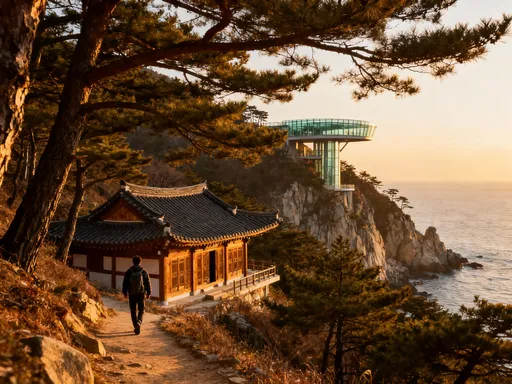
The centerpiece of the trail is the glass-floored observation deck that juts out over the cliffside, allowing visitors to look straight down to the rocks and waves below. While such features might feel out of place in more traditional settings, here they are integrated with restraint. The deck is framed in minimalist steel, its transparent surface reflecting the sky and clouds, making it appear to float. Nearby, weather-resistant viewing platforms are anchored into the rock with discreet supports, their curved railings echoing the shape of the coastline. Benches made from composite wood provide rest spots that blend into the surroundings, and lighting is kept low and warm to preserve the night sky.
These designs reflect a philosophy of enhancement rather than intrusion. Rather than building large pavilions or paved plazas, planners focused on creating moments of connection—places where the human eye can fully appreciate the scale and beauty of the landscape. Signage is minimal and informative, using QR codes for those who want deeper context. Even the trail surface varies: compacted gravel in sensitive areas reduces erosion, while stone steps in steeper sections ensure safety without industrializing the path. For families and casual hikers, Songdo offers accessibility without sacrificing authenticity. And for those interested in design, it demonstrates how modern architecture can serve as a lens—framing nature, not competing with it.
Hiking with Purpose: Understanding Design in Nature
Walking through Busan’s hills, it becomes clear that architecture here is not just about shelter or aesthetics. It’s about relationship—between people and place, past and present, form and function. To hike with awareness of these elements is to transform a simple walk into a richer, more meaningful journey. One key concept that underpins much of this design is pungsu, the Korean practice of siting buildings in harmony with natural landforms, water flow, and wind patterns. Unlike rigid formulas, pungsu is about sensitivity—reading the land and responding with care.
When you begin to notice these principles on the trail, new details come into focus. Look at how temple roofs curve gently upward, mimicking the shape of surrounding peaks. Observe how stone walls follow the grain of the hillside, using natural ledges as foundations. Notice how pathways avoid direct climbs, instead looping gradually to reduce strain on both body and soil. These choices are not random; they reflect a worldview in which humans are part of the landscape, not its masters. Even modern structures in Busan often honor this ethos, using materials that age naturally and forms that echo the environment.
For travelers, developing this awareness doesn’t require architectural training—just curiosity and attention. Ask yourself: Why is this building placed here? How does it interact with sunlight or wind? Does it draw your eye toward a particular view? These questions open a deeper layer of travel, one that values understanding over consumption. And in a world where many destinations feel increasingly homogenized, Busan’s fusion of trail and tradition offers something rare: a place where every step feels intentional, and every view tells a story.
Planning Your Own Architectural Hike in Busan
Ready to explore Busan’s architectural trails for yourself? The good news is that these experiences are accessible to hikers of all levels, thanks to well-maintained paths, clear signage, and excellent public transportation. Start by choosing a trail that matches your fitness and interest. Geumjeongsan offers moderate to challenging routes with rich historical architecture, ideal for those who enjoy a workout paired with cultural discovery. Beomeosa Temple Trail is slightly easier and perfect for a morning hike followed by tea at the temple grounds. Songdo Cloud Trails are family-friendly and accessible via cable car, making them great for visitors with limited mobility or young children.
Timing matters. Spring and autumn offer the most comfortable temperatures and vibrant scenery—cherry blossoms in April, golden foliage in November. Summer can be hot and humid, so start early and carry plenty of water. Winter hikes are possible too, especially on lower slopes, but be prepared for wind and occasional frost at higher elevations. Regardless of season, wear sturdy footwear with good grip—many trails have loose gravel or wet stones, especially after rain.
Getting there is straightforward. Most trailheads are reachable by subway or bus. Beomeosa Temple, for example, is a short walk from Beomeosa Station on Line 1. Geumjeongsan’s main entrance is accessible from Geumjeongsan Station, while Songdo Beach connects directly to the cable car station via a pedestrian bridge. Trail maps are available online and at tourist centers, and many routes have English signage. Consider downloading a local hiking app or carrying a printed guide to identify key architectural features along the way.
Finally, remember to hike with respect. Many of these sites are active religious or residential areas. Stay on marked paths, avoid touching or entering private structures, and keep noise levels low. Take only photos, leave only footprints. By doing so, you honor both the people who live here and the centuries of design wisdom embedded in the landscape. In Busan, hiking is more than exercise—it’s a conversation between past and present, nature and culture, movement and meaning. When you walk these hills, you’re not just passing through space. You’re becoming part of a living tradition.